
The Updated Behaviour Support Workflow: What the NDIS Requires and Why It Matters
The NDIS has specific legal timeframes for developing behaviour support plans. Many people have never been told what they are. Here’s what the workflow actually looks like.

This article has been adapted from an official NDIS media release, which can be read in full here.
This article is for anyone who is currently receiving, or about to begin receiving, behaviour support services through the NDIS. Whether you’ve been in the system for years or you’re just getting started, understanding how this process is supposed to work puts you in a much stronger position to ask the right questions and expect the right things.
At the end of this article, you will know:
- The two types of behaviour support plans and what each one does
- The legal timeframes that govern when each plan must be completed
- Why the process is rarely linear, and what that means in practice
- What determines your starting point when you engage with a new provider
- When a new Interim plan might be needed even after a Comprehensive plan exists
Here’s something most families never find out: from the moment a behaviour support practitioner is engaged, a legal clock starts ticking.
There are specific timeframes, set out in the NDIS legislation, for how quickly certain documents must be completed. Most people navigate the entire behaviour support process without ever knowing those timeframes exist. And without knowing them, it’s very difficult to know whether the support you’re receiving is meeting its obligations.
The NDIS (Restrictive Practices and Behaviour Support) Rules 2018 set out two critical timeframes under Section 19. Understanding both of them changes the way you look at the behaviour support process.
The two types of behaviour support plans
Before we get into the timeframes, it helps to understand the difference between the two types of plans.
An Interim Behaviour Support Plan
Is a shorter, more immediate document. Its primary purpose is to address risk right now, particularly where restrictive practices are in place. It’s not designed to be comprehensive. It’s designed to be timely. While the deeper assessment work is underway, the Interim Plan ensures that documented, considered strategies are in place to keep the participant and those around them safe.
A Comprehensive Behaviour Support Plan
This is the full version. It’s built on a Functional Behaviour Assessment, which is a thorough process of understanding why behaviours are occurring and what function they’re serving for the person. A Comprehensive BSP includes detailed proactive strategies, reactive strategies, and a plan for reducing or eliminating restrictive practices over time. It takes longer to develop because it’s built on a much deeper foundation of information.
Both are important. They serve different purposes at different points in the process.
The timeframes that the law requires
Under Section 19 of the NDIS (Restrictive Practices and Behaviour Support) Rules 2018, two timeframes apply from the date of engagement with a behaviour support practitioner:
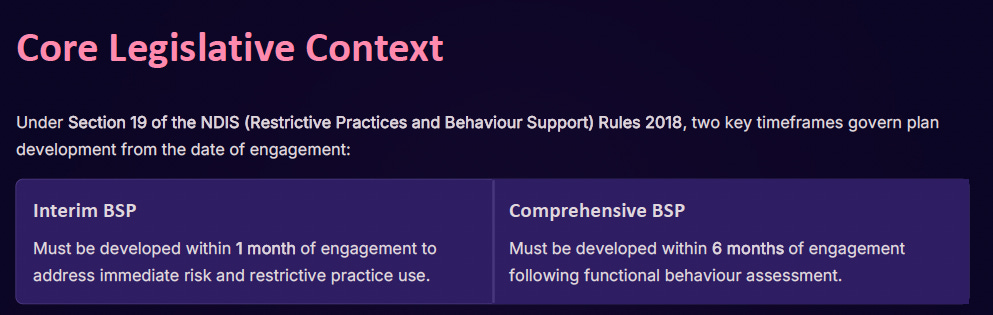
The Interim BSP must be completed within one month
One month from the date the practitioner is engaged. Not one month from the first meeting, or one month from when the paperwork is sorted. One month from engagement.
The Comprehensive BSP must be completed within six months
Six months from that same date, following the completion of the Functional Behaviour Assessment.
It’s worth noting how “engagement” is defined under this framework. Engagement is the date of allocation to a practitioner, as indicated in the Service Agreement. Importantly, if a practitioner changes within the same organisation, the original engagement date still applies. The clock doesn’t reset just because a different practitioner takes over the case.
These aren’t guidelines. They’re legislative requirements
Knowing them means you can ask your provider directly: when were we engaged, and where are we in relation to these timeframes?
The part nobody tells you: it’s not a straight line
Here’s where things get more complex, and more honest.
A common assumption about behaviour support is that it follows a clean, predictable sequence. Engage with a practitioner. Get an Interim BSP. Complete the Functional Behaviour Assessment. Develop the Comprehensive BSP. Done.
In reality, it doesn’t usually work like that.
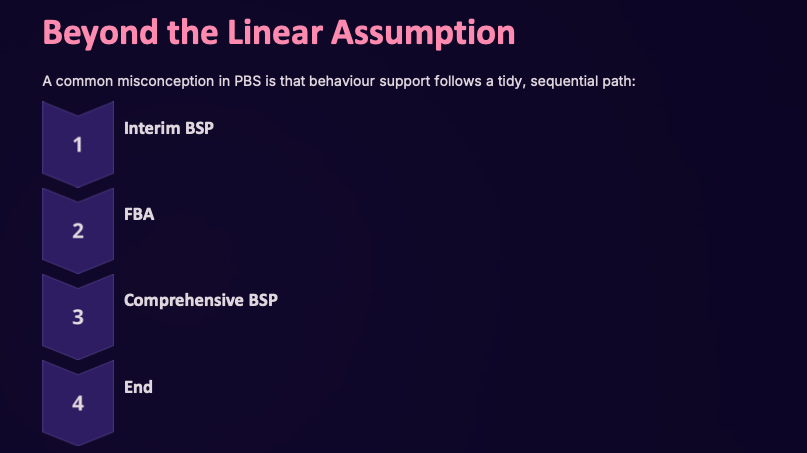
Real life is dynamic. Participants change providers. Circumstances shift. Risk levels fluctuate. Environments destabilise. Families go through difficult periods. A behaviour that seemed manageable six months ago can escalate significantly. And when any of those things happen, the behaviour support process needs to respond, not just continue following a predetermined path.
The practitioner’s role isn’t to follow a fixed sequence. It’s to identify and respond to the level of risk present at any given time. Sometimes that means going back to an Interim Plan even after a Comprehensive one has been completed.
This is important for families to understand, because the goal isn’t to get through the process as quickly as possible. The goal is to have the right plan in place at the right time, responding to what’s actually happening for the participant.
Where you start depends on what already exists
If you’re beginning with a new provider, your starting point isn’t automatically the same as someone engaging with PBS for the first time. It depends on what documentation already exists.
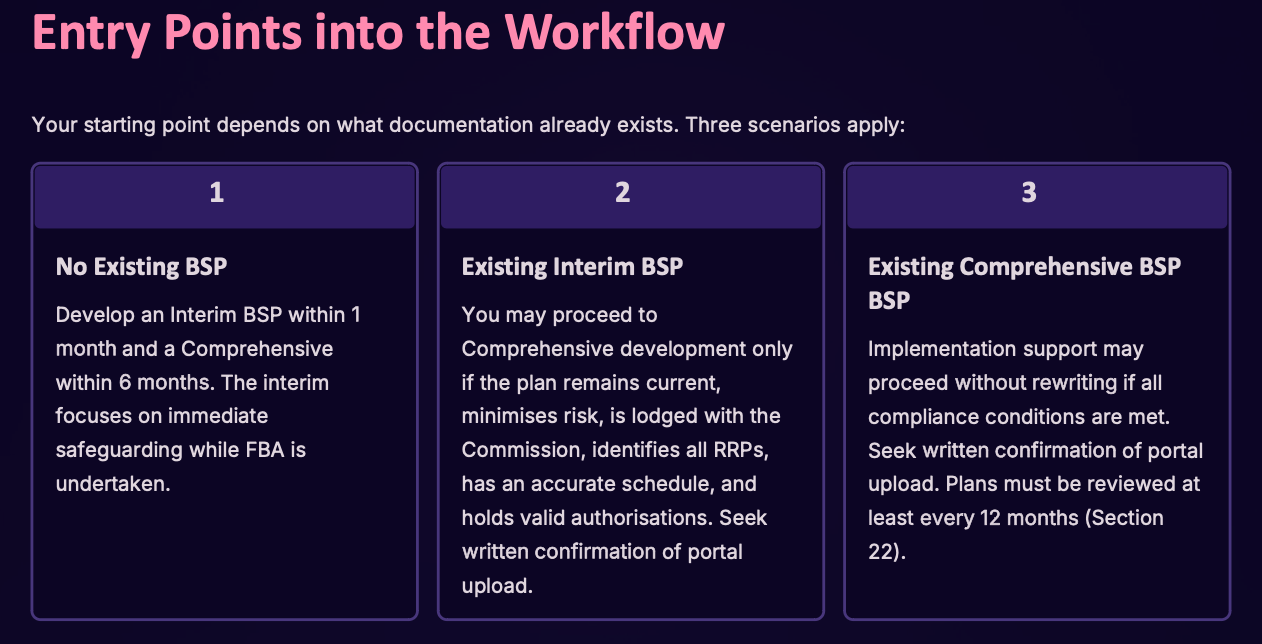
If there is no existing behaviour support plan
the practitioner must develop an Interim BSP within one month and a Comprehensive BSP within six months. The Interim Plan focuses on immediate safeguarding while the assessment work is underway.
If there is an existing Interim BSP
the practitioner can move toward Comprehensive Plan development — but only under certain conditions. The existing plan must still be current, it must be actively minimising risk, it must have been lodged with the NDIS Commission, it must identify all regulated restrictive practices in use, it must have an accurate schedule, and all necessary authorisations must be valid. If any of those conditions aren’t met, the plan needs to be addressed before moving forward. The practitioner should also seek written confirmation that the plan has been uploaded to the NDIS Commission Portal.
If there is an existing Comprehensive BSP
implementation support can proceed without needing to rewrite the plan — provided all compliance conditions are met. Again, written confirmation of portal upload should be sought. Under Section 22, all behaviour support plans must be reviewed at least every twelve months regardless of how well things are going.
The starting point isn’t arbitrary. It’s determined by what’s in place and whether it’s doing its job.
When a new Interim Plan might be needed
Even after a Comprehensive BSP has been developed, certain situations can require the development of a new Interim Plan. This is one of the most misunderstood parts of the process, and it’s worth being clear about.
A new Interim BSP may be needed when there has been a material change in the participant’s circumstances. This could be a change in living arrangements, a change in support workers or services, a significant life event, or anything else that meaningfully shifts the context in which the participant is being supported.
It may also be needed when risk escalates or new regulated restrictive practices are introduced, when existing authorisations have lapsed or documentation is no longer compliant, or when the Functional Behaviour Assessment is incomplete or the function of a behaviour is no longer well understood.
When reviewing an existing plan — whether Interim or Comprehensive — it’s worth asking a clear set of questions. Has the plan been uploaded to the NDIS Commission Portal? Is risk currently being controlled? Is the plan current and compliant with legislative requirements? Are all regulated restrictive practices authorised and being reported? Is the function of the behaviour clearly understood and addressed in the plan? And is the environment actually implementing the plan effectively?
A behaviour support plan that exists on paper but isn’t being implemented in practice isn’t protecting anyone.
What this means for families and support coordinators
Understanding this workflow isn’t just useful for practitioners. It’s useful for everyone involved in a participant’s support.
For families, it means knowing your rights. If you’ve recently engaged with a behaviour support practitioner and it’s been more than a month without an Interim BSP in place, that’s worth raising. If it’s been more than six months without a Comprehensive BSP, that’s also worth raising. These aren’t unreasonable expectations. They’re what the legislation requires.
For support coordinators, it means being able to monitor compliance across the participants you support. Knowing the engagement date and the relevant timeframes allows you to advocate effectively and escalate concerns when timelines aren’t being met.
For everyone, it means understanding that when the process feels like it’s going backwards — when a new Interim Plan is being developed after a Comprehensive one already existed — that’s not always a sign that something has gone wrong. Sometimes it’s a sign that the practitioner is responding appropriately to a change in circumstances. The test is whether the plan in place reflects current reality and is actively managing current risk.
Final words
Behaviour support is one of the more complex parts of the NDIS, and the workflow that governs it is more nuanced than it might appear on the surface. The legislative timeframes exist for good reason. They’re there to ensure that participants — particularly those with regulated restrictive practices in place — are never left without documented, considered support strategies for longer than is safe.
Knowing the framework doesn’t mean you need to become an expert in NDIS legislation. But it does mean you can have more informed conversations with practitioners and coordinators, ask the right questions, and understand what good practice looks like.
If you have questions about where a participant sits in this process, or whether the documentation in place is meeting its obligations, we’re always happy to talk it through.
From the Insight PBS team to yours :)
Resources
Read the full NDIS media release here
Read the NDIS’ guide to Behaviour Support
Read the NDIS steps to become a PBS practitioner
Read more of our blog articles here
Want to work with us? Check out our careers page.
Refer to Insight Positive Behaviour Support here.
Follow us on Youtube, Facebook, Instagram, LinkedIn, Twitter (X) and TikTok!
Want to discuss or have any questions about Positive Behaviour Support ? Feel free to contact us or request a callback.
Links
🔗 Follow Insight Positive Behaviour Support
📚 Learn more: